


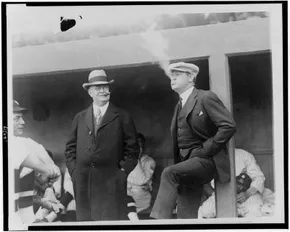
Babe Ruth was a monster on the field, but his mayhem off the field was just as impressive. When he arrived in New York in 1920, he didn’t just join the Yankees. He became a spectacle.
He moved his wife Helen from Boston to a luxury suite at the Astoria Hotel. Broadway was full of writers and politicians, but Ruth surprised them. His social life looked like a Hollywood script.
Hollywood stars and forgotten names
Ruth mixed with the elite. He knew movie stars. He also forgot their names. At one point, a teammate asked him where he was. Mr. Bei Bei mentioned a party with “movie people”. When pressed for names, he shrugged.
“Oh, what are their names anyway?”
The guests were Douglas Fairbanks and Mary Pickford. The biggest stars of the era. Ruth couldn’t remember them any better than his own teammate, Waite Hoyt.
The famous loved hanging out with him. Smugglers, politicians and Actors found his energy contagious. Helen did not. She hated the spotlight. Reporters chased them everywhere. The stress hit her hard. She retreated to their farm in Sudbury. She needed silence.
Crashed near Wawa
Speed was Ruth’s addiction. The Boston car accident hadn’t scared him. He kept buying fast cars. He kept wrecking them. As he ran through the lights toward the polo field, the cops often looked at him and let him go.
Then came July 20, 1920.
Ruth was driving to Philadelphia and Washington. He had Helen and three friends in the car. They were near Wawa, Pennsylvania. The night was dark. He took a curve too fast. The car skidded. It flipped.
Helen and coach Charley O’Leary were thrown clear. Ruth crawled out. O’Leary looked dead. Babe screamed for him to come back. O’Leary miraculously woke up. The car was totaled. They spent the night at a nearby farm. When they returned, Ruth told the mechanic to hold the wreckage. He was done with that car.
News reports claimed Ruth was dead. The Yankees party kept going to Philadelphia. After returning to New York, Babe bought the same model again. He had a bad knee, but he was alive.
Damage and silent films
1920 was a year of physical decline for Ruth. Muscle separation in April. I hurt my leg in May. influenza. In July, I could no longer move my wrist. In August, he used dirty tools to treat an arm that had been stung by a bee.
He missed 12 games. It’s luck. By his standards, he should have made more mistakes.
He was busy filming a silent comedy called “Headin’ Home.” The plot is simple. Slugger hit a home run to win against the girls. Starring Ruth. He needed batting practice for filming the movie. He appeared in the game with the paint still on his face.
This film earned him $15,000. He forgot to cash the check and lost $35,000 until the studio went bust. He is suing another company for $250,000 for using his photo in an instructional video. The judge dismissed it. The verdict is simple. Ruth was so famous that she didn’t have to agree to a photo shoot. He’s not just a player, he’s a phenomenon.
An unprecedented event
Brands want him. Politicians want him. Republican officials saw Ty Cobb endorsing James Cox. They wanted Ruth to join Warren Harding’s “Front Porch” campaign.
The value of the transaction was $4,000. Ruth refused at first. Money changed his mind. However, the Yankees’ schedule kept him in New York. He had never been to Ohio State. He never collected the cash. Ruth did not vote until 1944.
The media doesn’t care about politics. They care about him. In 1920, radio broadcasting was a novelty. Most people still read about baseball. Reporters followed his every move. They published the “Babe Ruth Box” in the newspaper. The notebook recorded his weight. They listed his daily meals.
He is everywhere.
The baby as the ultimate celebrity
“This year’s ‘Babe Ruth’ is more important than baseball itself,” said a New York Sun reporter, capturing the excitement of the early 1920s.
He wasn’t exaggerating.
The baby-sized Slugger is admired everywhere. Parents drag their kids to the park just to teach them. The handshake became a ritual, revered as much as the bare touch of boxing legend John L. Sullivan’s hand.
But this was not the tabloid nightmare we know today.
A negative press release is rare. If it exists, it is sugar coated or buried. Reporters and players traveled together on the train and kept in touch during the long journey. They didn’t betray each other’s secrets. Fans want live broadcasts and bright stories, not scandals. No one gets to treat more fluff than Ruth.
Writers collected nicknames. He was the Sultan of Swat. Babineau. Mr. Marsh. The praise continued uninterrupted throughout the morning, evening and evening editions.
“He was an anomaly,” Shirley Povich of the Washington Post recalled decades later. “Everyone knows the contributions he made to the game, but what may have come to light in later baseball records was overlooked at the time.”
His strength and flamboyant style shocked a country that was undergoing a transformation. Postwar Americans had money. they want to use it. The rigid moral walls of the past are crumbling.
In 1920, women got the right to vote. The radio replaced the phonograph as the mainstay of home entertainment. Although it is legally prohibited, young people in urban centers lead fast-paced lives and drink heavily.
Baseball has to evolve with the times. Ruth was the catalyst. His harsh talent was not only suited to the Jazz Age; It symbolizes fast-paced, reckless dreams.
So what did this hype mean to the Yankees of 1920?
The results were historic. Ruth isn’t just playing around. He redefined the game’s offensive power ceiling. His numbers for the season broke previous records and set a new standard for power hitting that hadn’t been reached in the league in years.
Details of his performance:
– Babe Ruth Baseball Statistics 1920
– How Babe Ruth Changed Baseball
– History of the New York Yankees


