




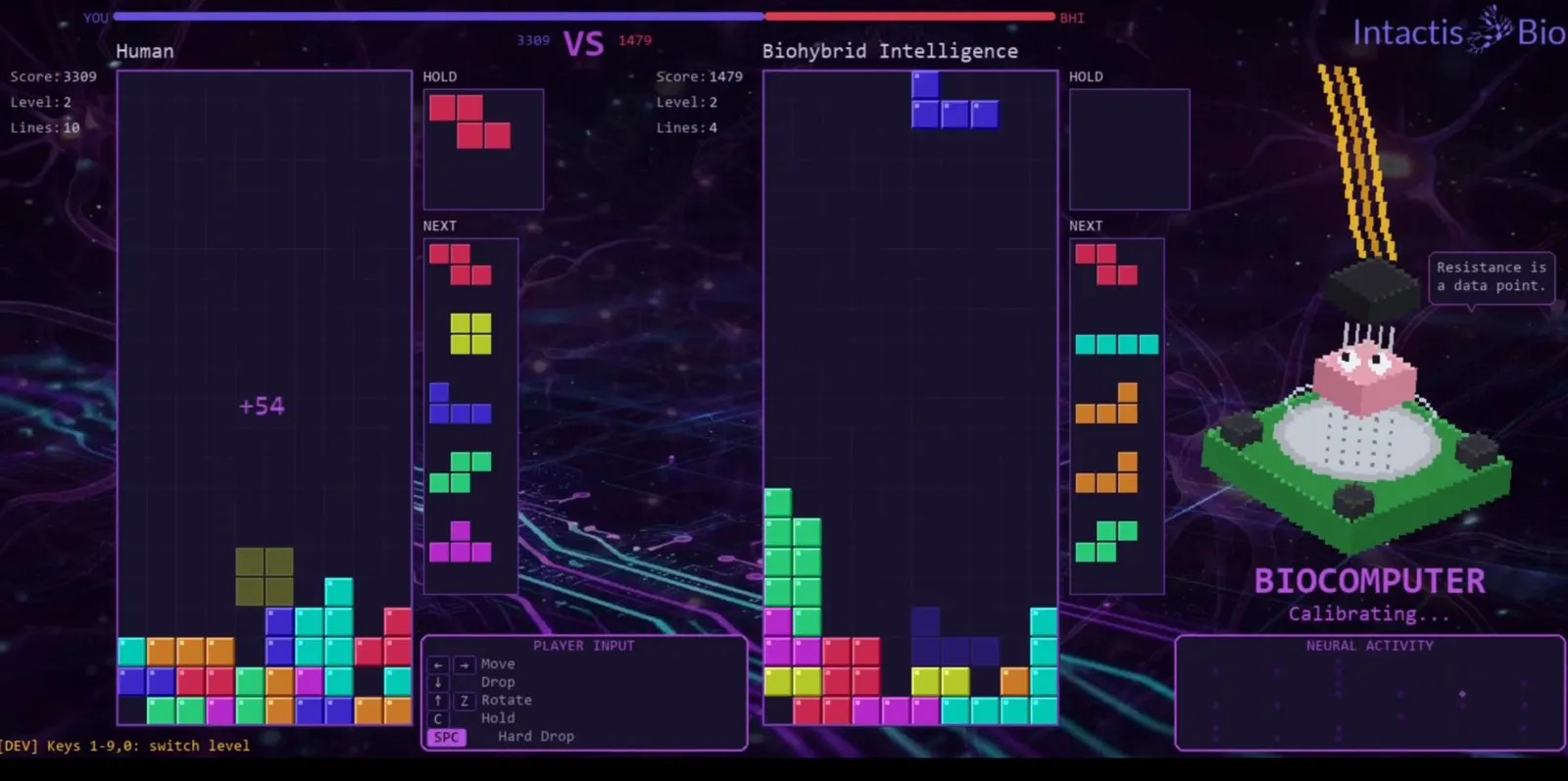
Intactis Bio wants you to beat brain cells at Tetris.
They launched Biostack. It is a game. But the opponent is not an algorithm or a human. It is neurons. Human neurons, derived from stem cells and packed into a rack that looks suspiciously like standard data center hardware.
Founder Daniel Rodriguez-Granrose calls it a biohybrid computer. That sounds sterile until you picture the biology. The neurons are “wrapped in cooling, life support, and signal.” They need to stay alive to think. To compute. To drop that last tetromino before you do.
The pitch is energy.
Intactis claims their biological substrate is up to three million times more efficient than silicon. Per decision. They project total cost savings of 90 percent in a market burning through billions in power bills. “This game offers a tactile example,” Rodriguez-Granrose says. You play against the machine. You see the value.
It took two years. One hundred and fifty interactions were optimized. The system doesn’t just react, it infers. The biotransformer model handles letters, numbers, equations. The cloud is open now, targeting customers who already spend $20k a month on compute. Data center partners are next.
Salt Lake City houses the team of 13. Rodriguez-Granrose, a former NSF fellow, leads them alongside Tim Cloutier. They sit inside Altitude Labs. Since 2024 they’ve raised a million dollars from grants and private eyes like RPV.
A Sector Born From Stem Cells
Twenty years ago, scientists made induced pluripotent stem cells. That work won a Nobel in 2012. Today, that biology is trying to power the digital age.
The industry is tiny. It is also moving fast.
FinalSpark
* Founded 2014 in Switzerland by Fred Jordan and Marin Kutter.
* Ten years in the making before launching in 2024.
* Uses 16 organoids with 10k neurons each.
* Gives away 30 TB of data.
Cortical Labs
* Australian start, 2019. Founders Hon Chong and Brett Kagan.
* Played Pong with brains in 2022. Launched the CL1 in 2025 Doom in 2026.
* $10 million seed round. Expanding into Singapore.
The Biological Computing Company
* Baltimore. Founded by two neurosurgeons, Alex Ksendzovsky and Jon Pomeraniec.
* Exited stealth in Feb 2025 with $25 million.
* Focuses on software adapters for video generation.
Other players lurk. MaxWell Biosystems provides the microelectrode arrays. The supply chain is waking up. But everyone calls their tech something different. Governance varies wildly. Ethical oversight is a moving target.
The Energy Problem
Look at the grid.
Global AI energy consumption is hitting 500 terawatt hours a year. By 2030? Maybe 1,000. One TWh powers a city for a decade.
Silicon is hitting a wall. The consensus view among some investors is grim: data center capex is unsustainable.
“The widening gap between what AI asks of Silicon and what silicon can return is a critical unlock.”
But don’t fall in love with the headline yet. Critics want a full audit. How much energy does it take to grow the neurons? Keep them warm? Replace them when they die? If the lifespan of the “wetware” is short, that efficiency metric drops like a stone.
Early adopters are betting on it anyway. They care more about the workflow than the physics. They burn cash. They build specialized apps for drones, vision systems, robotics.
The Inference Shift
Training models used to be the big cost. It’s not anymore.
Fusion Fund estimates that today’s compute demand flips: 80 percent for inference, 20 percent for training. That is an inversion of two years ago. GPUs are great at training. They are less great at the continuous, low-latence work of live inference.
Biocompute targets this gap.
The Thesis
- Silicon is hitting physical limits.
- Intelligence should be embodied. Continuous.
- Learning at the edge is cheaper than retraining from scratch.
Flourish Labs just raised $500 million from Jeff Bezos. They believe biology is the “ground truth” for building better AI. Lux Capital backs the contrarian view that centralized, frozen intelligence is a dead end. The future is distributed. It is wet. It learns as it works.
Intactis is small. They have $1 million. Cortical Labs has more. BioCC has the most. The audience is watching.
Play Biostack at play.intactis.bio if you want to lose.
The auction details are online. The beta testing signup is open. You can bet your own tokens if you like. No one knows yet if these brain-in-a-box machines can scale past a game of Tetris or Doom. But they are trying. And right now, trying looks cheaper than building another nuclear reactor to run ChatGPT.
Are you sure silicon was ever going to save us?