


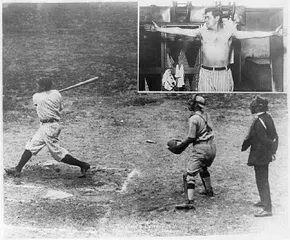
Babe Ruth is still here. More than a century after he was born and decades after his final swing, the mystique of the Babe Ruth legacy remains undimmed. The problem isn’t that the facts are wrong. It’s that the facts don’t matter as much as the story.
For fans under 65, the real Ruth is often obscured by cinematic filters. You’ve likely seen William Bendix in the 1948 film Babe Ruth or John Goodman in the 1993 TV movie. These portrayals didn’t just interpret history; they rewrote it. They turned a complex athlete into a cartoonish archetype. And the public ate it up.
Debunking the Hollywood Legend
Let’s clear the air on what didn’t happen. Ruth did not hit three home runs in his last game. He didn’t quit on the spot in a dramatic fashion. And he certainly didn’t need pinch-runners to jog around the bases for his final homer. That’s pure Hollywood fiction.
The image of the pot-bellied slugger is also a late-career construct. Ruth started his career as a dominant pitcher. He didn’t transform into the power hitter we remember until later. He was graceful, not grotesque, at the start.
Yet, people prefer the myth.
The Babe Ruth Museum ran a poll a few years ago. Visitors were asked if Ruth actually called his home run off Charlie Root in the 1932 World Series. The evidence was thin. There was little proof he did it, and some evidence suggesting he didn’t. Still, 97 percent of voters believed it happened. Why? Because it’s the Babe. People want to believe in the magic.
The Man Behind the Mythos
This wasn’t just about baseball. Ruth was worshipped like no other athlete before him. He was everywhere. His moon-shaped face was on cereal boxes, chewing tobacco, razors, and even underwear. Yes, Babe Ruth’s All-American Athletic Underwear was a real product.
More than 15 songs were written about him. Irving Berlin penned “Along Came Ruth.” In 1948, a forgettable posthumous track called “Safe at Home” claimed: “He was called out, here below, but he’s safe up there I know.”
H.G. Salsinger captured the duality shortly after Ruth’s death. He wrote that Ruth was “rowdy, rough, tough, profane, ribald, swaggering.” He had human faults. But he also had virtues. Honesty. Unselfishness. Charity. Ruth never pretended to be anything other than what he was. That authenticity resonated.
How Ruth’s Records Define His Career
Books on Babe Ruth’s career stats have proliferated since his death. From his autobiography to historical tomes released as Hank Aaron approached his record in 1974, the literature is vast. But which records still hold weight?
Ruth’s single-season home run record of 60 was broken. His career total of 714 was also surpassed. He is no longer the home run king. But if you look deeper, his dominance is undeniable.
Here is where he stands today:
– Third in career home runs
– Second in at-bats per home run (11.76)
– Second in RBI (2,211)
– First in slugging percentage (.690)
– Third in walks (2,062)
– Tied for ninth in batting average (.342)
There is one stat, however, that proves he was the greatest of them all. He was 94-46 as a pitcher with a 2.28 ERA.
He never pretended to be anything but what he was.
Ruth understood that records are meant to be broken. Even he said so. But being amazing isn’t just about the numbers. It’s about the presence. He was a kid at heart. A smile that spread from ear to ear.
In 1969, the Commissioner’s Office named him the greatest major league player of all time. That same year, his birthplace in Baltimore was saved from the wrecking ball by local businesspeople. In 1982, Ruth became one of the first three posthumous clients for Curtis Management, alongside James Dean and Elvis Presley. The firm has since added nearly 200 other clients, from Lou Gehrig to Malcolm X, all leveraging the power of icons.
Ruth left us a body of work that outlasts the stats. You can almost see him standing at home plate. Grinning. Winking. Sending the ball out of the park. The myth remains. The man is gone. But the game remembers.


