



Why #NASCAR avoids racing in wet weather: Tire physics and track safety
Driving in heavy rain is really painful. Visibility dropped to close to zero. Stopping distance is doubled. It became a gamble. Now imagine going 200 mph with no windshield wipers and bald tires. This is a death sentence. This is exactly why NASCAR does not race in the rain.
Other motor sports deal with slippery surfaces. It’s wet weather in F1. Rally cars also run well in mud and rain. NASCAR is not like that. The reason is not just a preference. These include physics, safety and sport-specific design.
When the dark clouds roll in, the preparation days disappear in minutes. Teams test tires at certain temperatures. They tuned the suspension to improve the track grip. They develop fuel strategies. If it rains, the board is reset. It kills competitiveness. It brings confusion.
To understand the wet driving ban, you need to know two things: tires and asphalt. Let’s start with rubber.
Slick tire physics
Normal road tires have grooves. These grooves act like channels. Pump the water off the contact surfaces. Over time these grooves deepen. Braking power is lost when the tread is lowered. On wet roads, the low tread can cause aquaplaning. The tires no longer touch the road surface. It grazes the water layer.
NASCAR tires are smooth. No tread. There are no grooves.
This design maximizes surface area. On a dry track, the largest contact surface corresponds to maximum grip. NASCAR cars generate immense force. They take corners at high bank angles. They accelerate. Slick tires provide the friction your car needs to go 200 miles per hour.
These tires solve a problem called slip angle.
When a NASCAR race car comes into a corner, its tires point in a slightly different direction than the vehicle’s direction of travel. The tires are slipping. This slip angle creates a lateral force. This allows the driver to change direction. The optimal sliding angle is about 2-4 degrees. If this value is exceeded, the car loses control. Wet tracks increase this risk exponentially. Water reduces friction. The glide angle becomes unstable. One moment you are turning. The next, you are spinning.
NASCAR has wet tires. they exist. Rarely used. Most tracks do not support them. Usually the weather varies too much. A safe race is hard to maintain. A competitive race is nearly impossible.
Montreal exception
There is one exception. In August 2008, the NAPA Auto Parts 200 in Montreal, Quebec changed history. NASCAR used wet tires for the first time in a points race.
The race started with slick tires. It’s raining. The race halted. The crew installed eight-year-old Goodyear rain tires and installed windshield wipers. Drivers tested the setup. They struggled with puddles. They avoided near-misses. Two drivers wrecked. The race was called after the halfway point.
Ron Fellows took the checkered flag. He won the first NASCAR race held on wet-weather equipment. This is a historic moment. It proved rain tires could work. The rules remain the same.
Road conditions and driver risks
In addition to the tires, the track itself is the enemy. Asphalt behaves differently when wet. Oil and dirt float to the surface. Visibility from the cockpit drops. Water spray from leading cars blinds following drivers. The racing line becomes slippery. There is no optimal path.
Drivers cannot trust the road surface. They cannot judge braking points. They cannot carry speed through corners. The gap between success and disaster is microscopic. In a sport where margins are already razor-thin, adding water removes the margin entirely.
The cancellation of a race affects everyone. Teams lose setup data. Broadcasters face a scheduling nightmare. Fans leave empty-handed. Sponsors see reduced exposure. However, the biggest concern is safety.
Is it worth risking a few wet laps? Data says no. The engineering says no. The history of single vehicle crashes on the slick oval suggests no.
NASCAR is still a dry weather sport. This is a carefully considered decision. It keeps drivers alive. It preserves the integrity of the race. It keeps the sport sustainable.
It’s raining again. Dark clouds are gathering. The crews will pack up. Fans are waiting for the sun to return.
Why #NASCAR cancels races in rain: Weepers, drainage and safety
Rain doesn’t just slow down NASCAR races. The clock stops completely. This is not meant to stop fans from watching. This is not intended to protect expensive equipment. It’s about physics and the terrifying reality of what happens when your tires lose traction on a track with flowing water.
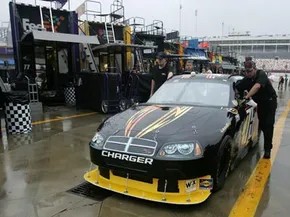
When the first drop of water hits the asphalt, a warning flag flies. The driver releases the gas pedal. The pace car takes them to pit road. The red flag goes down. The race is suspended.
Critics sometimes ask why they don’t just keep going. The engine is very hot. The tires are very hot. The driver already has a rhythm. Let’s see who wins. But racing on a wet NASCAR track isn’t just about ranking, it’s about life. The surface is not made for water. Designed for rubber and speed.
Danger of Weepers
NASCAR has a wide variety of tracks. Talladega is a super speedway. Bristol is a concrete bowl. But they all fail in the same way in water.
light rain? perhaps. Crew members may bring jet blowers. Blow air at high pressure to evaporate the moisture and dry the racing line. If the track dries out fast enough, the green flag drops again. The race resumes.
heavy rain? game over.
Water doesn’t just sit on the surface of the asphalt. It soaks in. pools underneath. Then find the exit.
This is where the Weepers come into play.
Weepers are streams that seeps through joints, cracks and joints in the road. They appear out of the blue. The road surface got wet in an instant. Then a jet of water erupts at 60 mph.
Imagine hitting a weeper at 180 miles per hour.
The car hydroplanes instantly. Grip is lost. The vehicle turns into a sled. Without grip, steering is useless. Brakes don’t matter. You are at the mercy of momentum and the obstacles in your way.
Cutting Grooves: a desperate measure
NASCAR knows the weepers well. They knew that many drainage systems were outdated or inadequate to handle the large volumes of water produced by storms.
In some cases, authorities may order crews to cut new grooves into the track surface. The saw blade cuts through the asphalt, creating channels that allow water to drain more efficiently. It’s a race against time. The faster the water can drain, the less likely you will suddenly violent weepers.
But cutting grooves is not the answer. This is a temporary relief. The fact is that the track is saturated. But the fact is that rain can reduce visibility. This does not change the fact that wet tires only have half the grip of dry tires.
Infield trap
Although the track itself is manageable, the infield tells a different story.
When a car slides off the track, it usually ends up on grass or gravel. In dry conditions this is a bit of a disadvantage. You can power out. You can return to the course with as little wasted time as possible.
in the rain? The infield turned into a mud pit.
Grip is zero on wet grass. The car spins into the infield and got stuck. It loses momentum completely. It may take several minutes or even a race’s worth of laps to release the car and return it to the track. Position is lost. Points are lost. The race isn’t just unsafe; it’s uncompetitive. for anyone who makes a mistake.
The Bottom Line
Canceling a race due to rain isn’t about being cautious. It’s about survival.
The combination of weepers, hydroplaning and infield traps creates a scenario where driver error isn’t the problem. The environment is
Even a light sprinkle is enough to stall a Cup Series event. The moment the track surface gets slick, officials pull the red flag. Drivers circle the pit lane or head to the garage, waiting for a crack of sunshine or a break in the clouds. If the sky stays gray, the race dies. It gets pushed.
NASCAR holds the gavel on these decisions. When moisture turns the asphalt into a mirror, the sanctioning body generally has two paths forward. The rules allow for a winner to be declared if the race has passed the halfway mark, even if conditions remain treacherous. At least half the scheduled laps must be completed for this to happen. Consider the Daytona 500. It is a 200-lap affair. If 101 laps are in the books and the heavens open up with no forecast of clearing, NASCAR can officially call it done. The leader on the track when the red flag waves takes the checkered flag. The trophy is handed out. The points are awarded.
If the field hasn’t reached that 50% threshold, the race is suspended. The question becomes: can the track dry out in time? If the delay doesn’t change the fundamental conditions—meaning the rain is just a temporary pause—the event can be rescheduled for the next raceable day. Usually, that is the following dry day. Sometimes, it is the next available race weekend.
That second option is a logistical nightmare. The NASCAR schedule is packed. There are very few open slots. Moving a race to a different weekend disrupts the entire flow of the season. Drivers and crew chiefs spend weeks preparing specific setups for specific tracks. A sudden shift limits practice time and throws off their rhythm. No one wants to see this happen.
The financial hit extends far beyond the track wall. Track owners, vendors, and fans all feel the pinch. On a standard weekend, hundreds of temporary workers are hired for concessions, security, and traffic control. If the race moves to a weekday or an unexpected date, those workers might already be back at their day jobs. They can’t come in. Track owners have to scramble to find replacements or pay overtime, which eats into their bottom line.
Vendors take a harder hit. People are less likely to brave the elements to buy a hat or a model car. Foot traffic drops. Revenue vanishes.
Then there is the advertising. Brands spend hundreds of thousands of dollars for specific slots. They are betting on a certain audience size and viewing time. When weather alters the schedule, those contracts become messy. Does the ad count if the race is delayed by two days? Does the audience shift? The terms change, and the money doesn’t always align with the new reality.
Ticket holders aren’t off the hook either. Yes, they can redeem their stubs for the new date. But they have to pay for gas again. They might owe for an extra night at the hotel. They could lose a day of wages if they have to take time off work to make the trip. It is a cascade of unexpected costs for a day of entertainment that vanished due to clouds.
None of this is desired. But it is necessary. Safety comes first. Competitiveness matters. You cannot race on a sheet of ice without risking lives and ruining the product. The delays and cancellations are the price of keeping the sport intact.
For more details on how the sport operates, look into the related articles on hypermiling, racing grooves, and broadcast mechanics.
Related HowStuffWorks Articles
-
What is hypermiling?
-
How Racing Grooves Work
-
How NASCAR Broadcasts Work
-
How the NASCAR Schedule Works
More Great Links
-
NASCAR
-
Stock Car Science
Sources
-
Allison, Liz. The Girls Guide to NASCAR. Center Street. New York. 2006.
-
Huller, Scott. A Little Bit Sideways: One Week Inside a NASCAR Winston Cup Race Team. MBI Publishing Company. 1999.
-
Lemasters, Ron. “Much More Than Race Day Lost When Rain Pours Down.” Feb. 27, 2008. (November 26, 2008) http://www.nascar.com/2008/news/business/02/27/rain.california.business/index.html
-
Leslie-Pelecky, Diandra. The Physics of NASCAR: How to Make Steel+Gas+Rubber=Speed. Dutton. 2008.
-
Leslie-Pelecky, Diandra. “What Is a Weeper?” (Nov. 20, 2008). http://www.stockcarscience.com/scienceTopics/scsTrack_Weepers.php
-
Martin, Mark. NASCAR for Dummies. Wiley Publishing, Inc. New York. 2000.
-
The Official NASCAR BUSCH Series Grand National Division Handbook. Harper Entertainment. 1998.
-
Sporting News Wire Service. “Fellows Wins on Rain Tires at Montreal’s Road Course.” Aug. 4, 2008. (Nov. 28, 2008). http://www.nascar.com/2008/news/headlines/bg/08/02/rfellows.montreal.winner/index.html