



Miller Huggins was dead. The beloved New York Yankees skipper succumbed to erysipelas in September 1929. For Babe Ruth, the vacancy wasn’t a tragedy. It was an opening.
The slugger saw a clear path to power. He wanted the Yankees manager job. He asked Ed Barrow. Barrow said no.
Instead, the front office went with Bob Shawkey. A former pitcher. A current coach. Quiet. Gentle. The opposite of Huggins’s snappy, irritable temperament. The team was pitching-poor and tired of abuse. Shawkey seemed like the safe, pedagogical choice.
Ruth grudgingly accepted the decision. He and Claire headed to spring training in St. Petersburg. He hadn’t signed a contract yet.
The Price of Principle
Ruth made $70,000 a year. He wanted $100,000. Colonel Jacob Ruppert, the team owner, offered a $5,000 bump to $75,000. Ruth refused. It wasn’t the money. It was the principle.
Christy Walsh drafted a letter. Ruth’s investments and endorsements would net him $25,000 a year for life if he quit today. The braggadocio lit up the press. Ruth backed down to $85,000 for three years. Ruppert countered with $80,000 for two.
Ruth kept playing during spring training. Then a reporter pointed out the obvious. If Babe got hurt while playing, his leverage vanished. He took the hint.
He issued an ultimatum. $85,000 by noon the next day or he walked away from baseball forever. The newspapers boiled.
Then he flipped.
By noon the next day, Ruth signed Ruppert’s terms. When someone noted he was now earning more than President Herbert Hoover, Ruth shrugged. “So what? I had a better year.” He was right. Ruppert also returned a $5,000 fine Ruth felt Huggins had unjustly levied in 1925.
Shawkey’s Short Reign
The 1930 Yankees started slow. Ruth was a walking injury report. He slid into third and hurt his foot. He tried to score on a fly ball and knocked himself unconscious diving into home. It took four men to carry him off the field.
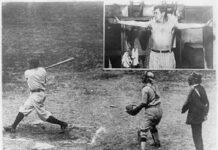
On May 21, 1930, at Shibe Park in Philadelphia, Ruth arrived at the plate. He hit three home runs in his first three at-bats. No one had hit four in a game since 1896. It is still rarer than a perfect game.
For some reason, he chose to bat right-handed for his final trip. He faced a right-handed pitcher. Two strikes. He switched back to the lefty side and struck out.
Shawkey’s personality clashed with the locker room. Players openly questioned why he wasn’t the manager. They undermined his easygoing style.
Shawkey and star pitcher Waite Hoyt didn’t see eye to eye. Mark Koenig joined the fallout. Both were traded to the Tigers in late May. The Yankees surged, getting within 2.5 games of the Athletics. Then Ruth tried to catch a fly ball before it cleared the fence. He ripped his fingernail off on the wire.
They finished 16 games back. Shawkey was fired.
Enter Joe McCarthy
Joe McCarthy replaced Shawkey. He had been dumped by the Cubs with four games left in the season. A coincidence of history: McCarthy had never played a day in the majors, yet he was the second batter Babe ever faced professionally in 1914.
Ruth made his desires known to everyone. Ruppert. Barrow. Anyone listening. He deserved the job. He questioned why New York hired a National Leaguer.
The 1931 spring training headline wasn’t baseball. It was Jackie Mitchell. The female pitcher struck out Ruth and Gehrig back-to-back in an exhibition. It felt like a publicity stunt. The accomplishment was quickly dismissed.
Opening Day 1931 brought violence. Ruth tried to score from third on a short fly ball. He collided with Boston catcher Charlie Berry. Berry was a former All-American football player. The collision was furious.
Ruth returned to the outfield. He collapsed trying to chase a fly ball. Nerves in his thigh paralyzed. He was hospitalized for 10 days.
The Yankees trailed Philadelphia and Washington early. They were out of the pennant race.
Then they clicked.
Under McCarthy, the team improved. By June 1, they were eight games over .500. By July, they were 17 over. They slipped past Washington to finish second, 131/2 games out.
Two factors drove this turnaround.
Lefty Gomez emerged as a star. The rookie went 21-9.
McCarthy’s strict discipline took hold. He set inflexible rules. Jackets and ties on the road. Breakfast in the dining room by 8:30 AM.
The Babe was excused from breakfast. If he showed up in a public eatery, the crowds would crush the team.
McCarthy’s toughness was fair. It worked. In 30 years of managing, his teams finished in the second division only once. His lifetime winning percentage, .614, remains the highest ever.
Ruth’s ambition died with Huggins. The manager’s job went to others. But the Yankees were learning to win. Not because of the slugger. Despite him.
The Last Big Season
The offense was a machine. The Yankees led the American League in hits, runs, homers, RBIs, walks, batting average, on-base percentage, and slugging average. Ruth, at 36, still batted .373. He was second only to the league leader. Lou Gehrig and Ruth tied for the home run title with 46 each. Gehrig set the all-time American League record with 184 RBIs.
Pitching was the weak link. Only one pinstriped hurler, besides Lefty Gomez, posted an ERA below 4.28. Gomez appeared in more than 18 games with a 2.63 ERA. The rest of the staff struggled.
On August 21, Ruth hit his 600th career home run in St. Louis. He made $80,000. That was twice as much as any other active player. Rogers Hornsby, the playing manager, was next in line. Ty Cobb had made $80,000 in 1927 while with the Athletics.
Ruth had changed. He was no longer the free-spending playboy. Writers noted he became an unofficial financial consultant for his teammates. He offered free advice on trust funds. The man who led the world in expensive hijinks now preached fiscal responsibility.
That December, he played Santa Claus for 300 kids in city hospitals. A reporter asked about his greatest feat of 1931. Ruth replied candidly. “Shooting a 73 at St. Alban’s golf course in December.”
The Depression Hits
Ruth handled his income well. The Depression deepened for the rest of the nation. Baseball owners de-juiced the ball for the 1931 season. They had livened it up for 1930 and set attendance records. The change was stark. American League home runs fell by nearly 100. The league batting average dropped 10 points. Attendance fell, too.
The owners had a plan. Players with lower averages could not demand raises. They cried poor and cut costs for 1932. Judge Landis reduced his salary from $65,000 to $50,000. The Yankees wanted to cut Babe Ruth’s salary by $10,000. They offered $70,000.
The logic was disingenuous. Ruth was the largest drawing card. Former co-owner Colonel Tillinghast Huston estimated Ruth added 2,500 paying admissions to every game. One commentator calculated that meant $280,000 per season. Another writer stated Ruth earned $3,500,000 for Colonel Ruppert over twelve years. That was over and above what the club would have taken in without him.
Money from exhibition games alone paid his salary every year since 1927. Ruth signed a blank contract. Ruppert filled it in with $75,000. Ruth also received 25 percent of the net receipts of exhibition games.
His body was wearing down. His most legendary moment lay ahead. It was in the 1932 World Series.