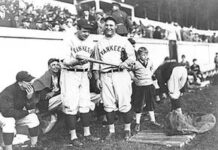




The end of Babe Ruth’s playing career wasn’t a dramatic collapse on the field. It was a slow, embarrassing unraveling in a boardroom. By 1935, the deal Ruth signed with the Boston Braves had soured. He realized there was no management track waiting for him. The promise was fake. The result was inevitable. He wanted out.
What followed wasn’t a heroic farewell tour. It was a bitter feud between the legend and the owner. Emil Fuchs. The Judge. They were at war. Ruth stopped showing up to promotional events. He snubbed merchants who wanted to cash in on his name. One angry shopkeeper returned 500 unsold tickets because the Babe ignored him.
The Knees Give Out
Ruth knew he couldn’t play anymore. He just couldn’t.
Wally Berger, his center fielder, put it plainly. “He couldn’t turn,” Berger recalled. “He’d go in pretty good to field a ball, but he couldn’t turn on those damn knees and ankles.”
If a ball went toward right field, Berger had to run double-time to back him up. The man who carried the Yankees to championships was now relying on others to carry him. It broke him.
On May 12, Ruth went to Fuchs and manager Bill McKechnie. He asked to be put on the voluntarily retired list. The logic was flawed but desperate. If he retired voluntarily, he could stay on the Braves’ roster without playing. He hoped this maneuver would keep his titles and his fading managerial dreams alive.
Fuchs saw an opening. The team was heading on a western road trip where ticket sales were expected to be huge. The Judge convinced Ruth to stay on the roster for a few more weeks. “I’d be mighty sorry if he retired,” Fuchs said, sweet-talking the fallen hero. “Perhaps this trip will restore his peace of mind.”
Three Home Runs at Forbes Field
It didn’t start well. The Braves played poorly in St. Louis and Chicago. Ruth’s batting average plummeted to .155. He complained of watering eyes and a persistent cold.
But then came Pittsburgh.
Against the Cubs on May 21, Ruth homered and made two fine catches. It looked like his swing was waking up. The team moved to Forbes Field, home of the Pirates.
The finale of that series was Saturday, May 25.
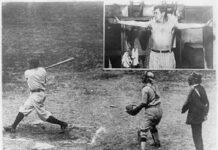
Babe faced lefty Red Lucas in the first inning. He hit a two-run homer into the lower right-field grandstands. Then, in the third inning, former Cubs bench jockey Guy Bush took the mound against him. The result was identical. Another two-run homer, this one into the upper grandstands.
By the fifth, Ruth had a run-scoring single. Bush stayed in the game.
In the seventh, Ruth came to the plate again. He connected on a curveball. The ball flew fifty feet over the double-deck roof in right field. It cleared the park completely.
It was the first time anyone had done that at Forbes Field.
It was only the second time in his career that Ruth had hit three home runs in a single game. Guy Bush tipped his hat as the Babe limped around the bases. “I never saw a ball hit so hard before or since,” Bush said.
The Babe still had the pop. It was his 714th major league home run. The last one.
The Knee and the Ocean Liner
The physical damage was winning. His wife Claire, traveling secretary Duffy Lewis, and others told him to quit right then. Ruth muttered something about finishing the trip. He kept plodding on.
The slide continued. Cincinnati struck him out three times in one day. He went hitless in three games. He struck out twice and walked twice in Philadelphia on May 29. Both cities had given him Babe Ruth Days. He took the applause and the strikeouts.
Then came the end.
On May 30, during the first game of a Memorial Day doubleheader against the Phillies, Ruth chased a fly ball in the first inning. He hurt his knee. He left the game. The Braves got swept.
He never played in the majors again.
Fuchs was desperate. He was losing money every month and had borrowed against his Braves stock. The feud intensified. Fuchs yelled at Ruth for missing a doubleheader in Boston. Babe claimed his knee was too sore.
The final straw came when Ruth asked for a few days off. He wanted to go to New York. He had a booked seat on a swanky reception aboard the luxury ocean liner Normandie. He figured his injury would keep him out of the next series against the Dodgers anyway. What was the harm?
“Nothing doing!” Fuchs snapped. “You stay here.”
Babe supposedly offered to play in an exhibition game in Haverhill, Massachusetts, to appease the owner. Fuchs wouldn’t budge. The pressure point was reached.
The Voluntary Retirement
In the middle of the afternoon game against the Giants, Ruth sent a message to the press box. He had something to say.
Reporters gathered quickly in the clubhouse. The atmosphere was tense. Ruth looked tired.
“I hate to say what I’m going to say,” he told them. “I’m not quitting, but I’m going on the voluntary retired list. That means I can’t play for at least 60 days anyway.”
He made his terms clear. He didn’t want to leave baseball entirely. He just couldn’t work for Fuchs.
“If Judge Fuchs were to sever connections with the Braves, I’d gladly come back,” Ruth said. “But I won’t have anything to do with the club as long as Judge Fuchs has.”
The deal was dead. The Babe was done. The end of an era didn’t come with a final out. It came with a demand for an exit from a specific man. The baseball world watched the legend walk away, not because he couldn’t play, but because he wouldn’t tolerate the humiliation anymore.
The lights went out. Not with a bang. With a contract dispute.
The Aftermath of a Trade
The reaction to Ruth’s departure was mostly what you’d expect. McKechnie claimed he was sorry to see the slugger go. He also denied ever saying Ruth broke training rules or team regulations. Before the game, Braves players swarmed Ruth for autographs. He told them about his plans. Fuchs gave him an unconditional release. The owner made a ridiculous claim. “I did everything I could to help him along,” Fuchs said. “But I guess it wasn’t to be.”
Ruth and his family left the next morning. They drove back to New York. McKechnie came to see them off. Babe later said this proved the manager held no ill will. If McKechnie thought Ruth was disrupting the club, it was clear they were worse off without him.
Braves in the Basement
The Braves were 10-27. They sat in last place as Babe drove away. They wound up with a 38-115 record. This was the worst record by any National League team in the 20th century. They finished 61.5 games out of first. They were also 26 games out of seventh.
How bad were they? Ruth posted a .181 batting average. He had only 71 at-bats. Yet his six home runs ranked second on the team.
Was there any consolation for Babe? It came in July. Fuchs was forced to sell out to Charles Adams. A little over a year later, the Judge declared bankruptcy.
The Shut Out
Ruth was optimistic at his Boston press conference. He was not returning to major league baseball in 60 days. He would not return ever as a player. Fuchs had a bad reputation among owners. He was seen as a near-bankrupt bumbler. Yet he had the support of his peers. They evaluated player attitude. If the Judge said Babe was a bad soldier, he was one. Owners did not want him in their organizations. It was the old boy network in full force. Babe was the victim.
He still hoped for a managerial post. Ed Barrow and Jacob Ruppert of the Yankees shut him out. He erred in judgment with Frank Navin of Detroit. He came close to jobs in Philadelphia and Boston. Surely there would be more chances. He would be ready.
The offers never came.
“It was the biggest disappointment of his life,” Ruth’s daughter Julia Ruth Stevens said. She spoke 60 years after the Braves fiasco. “He felt even if he didn’t make good — and he was sure that he would — he should have been given the chance. That’s what hurt him the most.”
Ruth proudly said during the 1935 World Series that if owners did not give him a shot by the winter meetings in December, “I’ll look outside baseball for a job.” Just like his last salary demands, the threat caused no stir. Barrow and Colonel Ruppert ignored him. Babe was out of the game.
But Babe Ruth did not fade into the shadows. He had other plans.