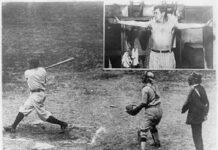




The 1920 American League pennant race ended without a Yankees title. That was not Babe Ruth’s fault. In fact, his performance that year might be the greatest individual offensive display in baseball history.
The rules of the game had just shifted. The ball’s core was tightened by new manufacturing technology. It came out of the bat faster. Ruth thrived in this environment. He smashed the ball with a frequency that redefined power hitting.
Then came the tragedy. Ray Chapman, the Cleveland infielder, was killed by a pitch in September. The sport was traumatized. Before the 1921 season started, officials changed the rules again. They banned defaced pitches. Spitballs and emery pitches were out. Any dirty ball had to be pulled from play immediately.
The ball became livened up even further.
Babe Ruth loved the bright, shiny new sphere. He put up bigger numbers than in 1920. The Yankees finally reached the World Series for the first time in their history. But off the field, the situation was a disaster.
The Money Pit
Ruth weighed 240 pounds. He was imposing. But his financial management was nonexistent.
He grew up without money. He had no discipline once it arrived. He spent his earnings the moment they hit his hands. Endorsement checks disappeared. Newspaper columns ghost-written under his name vanished into debt. He left $50 tips for ham sandwiches. It was common practice for the era’s most famous athlete.
After the 1920 season, Ruth traveled to Cuba. He fell for a horse-racing scam. A terrible error in judgment. He lost $25,000. He gambled away nearly all his $40,000 earnings from the trip. He invested in movies that never got filmed.
Then there was the lawsuit.
He sued the Curtiss Candy Company over “Baby Ruth” bars. He claimed they were named for him. The company argued the candy was named for Cleveland’s daughter. She had died 17 years earlier. The judge believed Curtiss. The ruling was even harsher: Ruth could not market his own candy under the name “Ruth’s Home Run.”
The Sporting News mocked him. They wrote about giants with the brains of boys.
Enter Christy Walsh
Ruth needed saving. He needed Christy Walsh.
Walsh was a promoter with a plan. He wanted to syndicate sports columns under famous athletes’ names. He needed Ruth to sign on. Walsh used a ruse involving beer deliveries to get an audience. He promised a fortune. He handed over $1,000 before spring training.
It was a lifeline. Walsh had borrowed that $1,000 to secure the deal.
The partnership was profitable. Before Walsh, Ruth made about $500 from ghostwriting. In 1921, he made $15,000. Walsh built an empire using Ruth as the centerpiece. The syndicated columns included voices from Knute Rockne to John McGraw.
More importantly, Walsh became his financial adviser. He put the money into safe investments. Those investments protected Ruth during the Great Depression. It was exactly what the Babe needed to survive his own lifestyle.
Spring Training Chaos
Ruth arrived at spring training in Shreveport, Louisiana. He had lost 10 pounds in the baths of Hot Springs. The rest of the trip was high energy.
A local car dealer gave Ruth free use of a fancy Essex. It had no license plate. The spare tire cover read “Babe Ruth’s Essex” in bright letters. He drove it around Shreveport. He had fun.
The rest of the Yankees followed suit. They threw raucous parties. Then they played baseball. The results were highly successful.
The Dodgers and Yankees traveled north together after camp. They played 14 exhibition games. The Yankees won nine times.
The roster was changing. Frank “Home Run” Baker left retirement to join the Yanks. Waite Hoyt arrived on his way to a brilliant pitching career. Wally Schang, a muscular catcher, came over from the Red Sox. The Yankees were pillaging the once-glorious Boston franchise.
The Red Sox seemed hypnotized during these trades.
Ed Barrow also arrived. He was not a player. He was a manager. He had led the Red Sox to the 1918 World Series. He was gruff. He had bushy eyebrows. He had a rugged countenance.
The Yankees hired him because he had a keen eye for talent. He had signed Honus Wagner early in his career. He was instrumental in building the Yankees’ legends. He also helped create the first Yankee farm system. The deals made Boston impoverished and New York legendary.
Ruth on the Field
The season started. Ruth killed the ball.
By mid-June, he had 24 home runs. Seven came in a five-day stretch. In the first 18 days of July, he added eight more.
These were not cheap shots. Local writers noted the distance. He hit the longest balls ever recorded in Washington D.C., St. Louis, Detroit, and Shibe Park in Philadelphia.
Babe showed baseball smarts too. When infielders played him back, he bunted for infield singles. He adapted. He understood the geometry of the infield.
His legal troubles did not stop. He was sued for unpaid automobile taxes on his Stutz Bearcat.
On June 8, he was pulled over for speeding. It was the second time that year. The judge fined him $100. Ruth paid by pulling a single C-note from his pocket.
The judge demanded he spend the day in jail. It was a second offense. The law was the law, regardless of fame. Or was it? The consequences hung in the air as the season wore on.
The Cell Block Dress-Up
Imagine getting dressed in a jail cell. That is exactly what happened before one of Babe Ruth’s most famous games in 1921. Police had forced him to stew in a holding cell for hours after a night out. Rather than showing up in street clothes or looking defeated, Ruth demanded his game uniform. He put it on right there in the cell.
When he finally stepped out, the scene was surreal. A thousand fans lined the streets to cheer him on. Newspaper photographers and newsreel crews captured the moment, turning a legal scrape into a legendary moment of baseball lore. It wasn’t just about hitting home runs anymore. It was about the man who couldn’t stay out of trouble but always showed up ready to play.
Speeding Through New York
While his home run record broke the sport open, Ruth’s driving was where his recklessness truly shined. If you walked down Riverside Drive in New York during that era, you likely saw him. He was behind the wheel of the most expensive cars money could buy. He drove fast. He drove carelessly.
He treated city streets like a private race track. The bill always came due, though. He spent a fortune paying for his own wreckage. Whether it was ramming into objects or accumulating speeding tickets, Ruth never let anyone else foot the bill for his chaotic commuting.
The Cost of Chaos
This reckless behavior didn’t come without physical consequences. You might think a body built like Ruth’s could shrug off anything, but he didn’t always walk away unscathed from these antics. The drama wasn’t limited to the courtroom or the highway.
To understand the full extent of his physical toll during that pivotal year, you have to look at how his body held up under pressure.
Looking Ahead
The injuries Ruth sustained during the 1921 World Series tell a different side of the story. They reveal the human cost behind the larger-than-life persona.
Want to dig deeper into the sport’s history?
– Explore the history of Baseball
– Check out Minor League Baseball roots
– Visit the Baseball Hall of Fame