




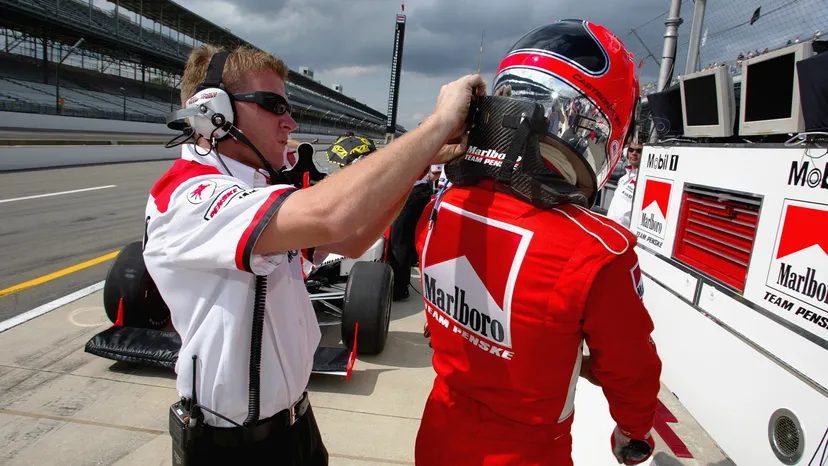
Car racing used to be a death sentence waiting to happen. One wrong move and you were gone. Patrick Jacquemart learned that the hard way at Mid-Ohio in 1981. He slammed head-on into a dirt bank. The car looked fine. Jacquemart did not. He suffered a skull fracture that caused severe brain damage. He died from it.
That tragedy sparked an idea. Jacquemart’s friends, Jim Downing and Dr. Bob Hubbard, decided to stop these deaths. They combined Downing’s racing knowledge with Hubbard’s engineering and anatomy skills. They built something simple. It worked. It changed everything.
The invention became known as the HANS device. That stands for “head and neck support.”
What Is the HANS Device and How Does It Work?
Think of a car airbag. It inflates to cushion a crash. The HANS device does not inflate. It is a raised collar with two tethers. It secures the driver’s head.
The collar attaches to the safety harness and the helmet. This keeps the head and neck aligned with the torso during a crash. Without it, the head snaps forward. That excess force causes serious neck and head injuries. The HANS device prevents that snap.
It targets basilar skull fractures. These are the injuries that kill drivers. They happen during sudden deceleration. This change in velocity is called Delta v.
Why Did NASCAR Ignore Safety for So Long?
The HANS device took years to sell. It was not a financial success at first. Racing organizations ignored it. NASCAR ignored it.
Then Dale Earnhardt Sr. died.
It happened in 2001 at Daytona International Speedway. The crash was similar to Jacquemart’s. Earnhardt hit the wall at 160 mph. He slowed by 42 to 44 mph in just 80 milliseconds. NASCAR called it a basilar skull fracture.
That death woke everyone up.
NASCAR took the HANS device seriously after Earnhardt’s crash. Now, most racing organizations require it. Drivers must wear it.
Did the HANS Device Save Lives?
It is hard to count exact lives saved. But the numbers tell a story.
NASCAR made certified HANS devices mandatory. There were no driver fatalities in NASCAR for 10 years after Earnhardt’s death. That era emphasized safety.
Compare that to drag strips and short tracks. There, HANS devices are not required. 126 drivers died in crashes. HANS estimates that 27 percent of those deaths could have been prevented. That is 34 drivers.
No driver in Indy car or NASCAR’s major series has died from a basilar skull fracture since the HANS requirement.
Who Invented the HANS Device?
Dr. Bob Hubbard co-invented the device. He died on February 5, 2019. He was 75 years old.
Hubbard was more than just a safety inventor. He worked on vehicle safety for General Motors. He was a professor of materials science and mechanics at Michigan State University until he retired in 2006.
His work saved racers. It saved drivers. It saved fans who watched in horror.
The sport is faster now. The cars are stronger. But the neck support remains vital. Racers still push limits. They still risk everything.
The HANS device is just one layer. It is a thick layer. But it is not the only one.
Safety keeps improving. It always will. Because someone always gets hurt. And someone else always builds a better shield.